
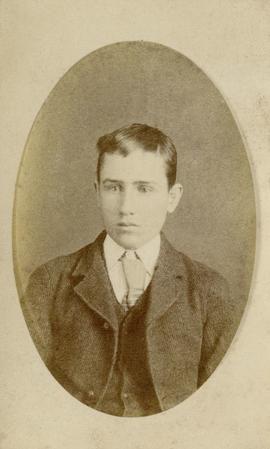
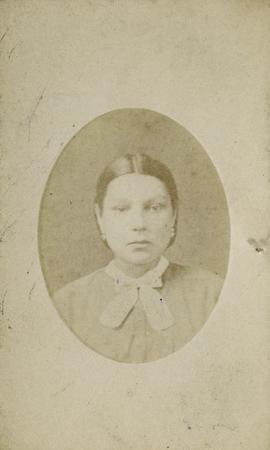
![[Portrait of] Sarah Shee-at-ston](/uploads/r/null/9/f/a/9fa20b8378bbe9ea16cdd4d3a8fe258fe7d597eb4c68b534f87ffdd8e3a854d6/a039279ac_142.jpg)
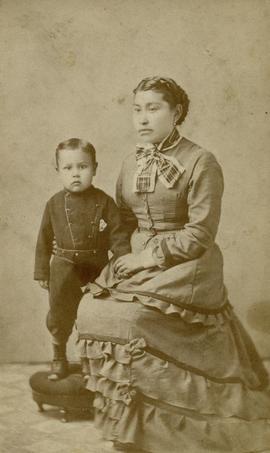
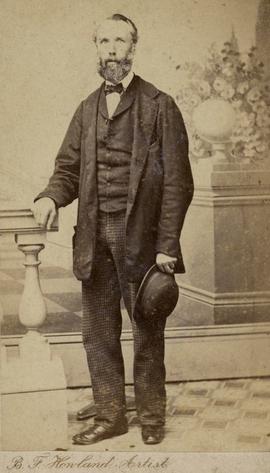
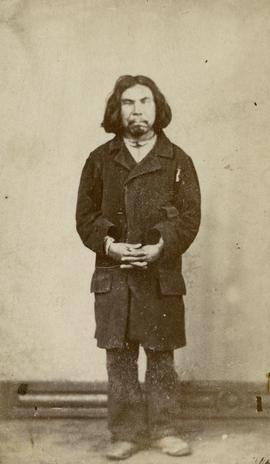

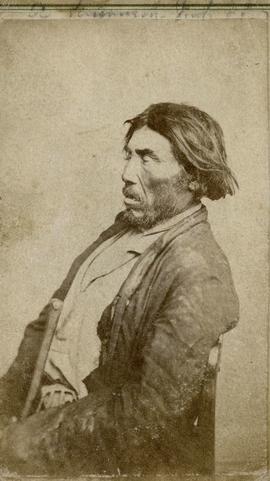
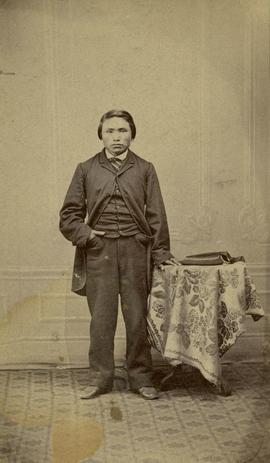
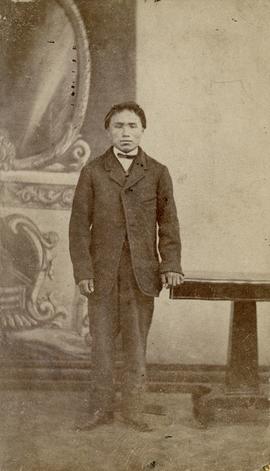
![[Portrait of doctor's wife]](/uploads/r/null/2/c/b/2cbdbf9bd42bd0e327b017af67274459ab6adb0b5c84953fc83bdb73b04350d6/a039290ac_142.jpg)
![[Portrait of woman in blanket]](/uploads/r/null/5/0/f/50fcfd5122359d2482ea74177fa01bca90d72dd9161b5cf8f6d055b3f22ac07d/a039291ac_142.jpg)
![[Portrait of man seated with cane]](/uploads/r/null/c/c/a/cca1eb067aea8cb961d077ca52f28a0975a75d282ffc1339a63fbc6bbdb1b02f/a039293c_142.jpg)
![[Portrait of woman seated on tile floor]](/uploads/r/null/4/2/2/422d87b0d18cd5499ad9772ac9c6d4ca9a84dbd262f9f64e54c1e5688857a095/a039294ac_142.jpg)
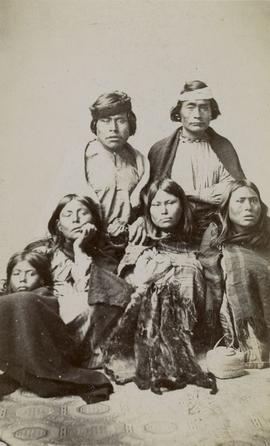
![[Fort Rupert woman wrapped in blanket, B. C.]](/uploads/r/null/1/d/4/1d4145e729fe795bcfc52c65e4eb128a13368dbee7109b66f1c31c7a693a1bf6/a039298ac_142.jpg)
Title and statement of responsibility area
Title proper
General material designation
Graphic material
Textual record
Object
Parallel title
Other title information
Title statements of responsibility
Title notes
- Source of title proper: Title based on name of the creator of the records
Level of description
Reference code
Edition statement
Edition statement of responsibility
Statement of scale (cartographic)
Statement of projection (cartographic)
Statement of coordinates (cartographic)
Statement of scale (architectural)
Issuing jurisdiction and denomination (philatelic)
Dates of creation area
Date(s)
-
1863 - [199-], predominantly 1863 - [191-] (Creation)
- Creation
- Thomas Crosby
Physical description area
Physical description
13.5 cm of graphic materials
25 cm textual records
3 objects
Publisher's series area
Title proper of publisher's series
Parallel titles of publisher's series
Other title information of publisher's series
Statement of responsibility relating to publisher's series
Numbering within publisher's series
Note on publisher's series
Archival description area
Name of creator
Biographical history
Rev. Thomas Crosby, son of Thomas Crosby and Mary Ward, was born in Pickering, Yorkshire, England on June 21, 1840. In 1856, Crosby migrated to Canada with his parents, settling near Woodstock, Upper Canada. In 1858 he joined the Wesleyan Methodist Church and became a preacher. In 1861, Crosby was working as a tanner in Woodstock when he read a call in the Methodist Christian Guardian (Toronto) for missionaries to work on the west coast. He left his job and paid his own way to Vancouver Island, arriving in Victoria in 1862.
In 1863, Crosby worked as an assistant to Cornelius Bryant at a Methodist mission in Nanaimo. In Nanaimo, Crosby met his first protégé Santana (later renamed to David Sallosalton) who joined Crosby in his efforts. Crosby and David lived and worked together. David was well known for his “Steamboat Whistle Sermon” but passed away in 1873 at the age of 19 from tuberculosis. In 1869, he was moved to the missions on the lower mainland, where Chilliwack was his home base. His success was rewarded in 1871 with ordination to the ministry in the Wesleyan Methodist Church in Canada. In the winter of 1873–74, Rev. Crosby toured Ontario to raise funds for missions and to search for a wife.
Emma Jane Douse, daughter of John Douse and Eliza Milner, was born on April 14, 1849 in Cobourg, Ontario. Her father, John Douse, had emigrated from England in the early 1830s to convert the Six Nations, and by Emma's birth in 1849 was a highly respected Methodist minister in Ontario. Emma trained at Hamilton's Wesleyan Female College, an institution offering higher learning for women in literature and classics. After completing her education, Emma became a teacher at Wesleyan Female College. In late January 1874, Rev. Crosby spoke at Emma’s College about supporting the missionary effort. Short weeks after meeting Rev. Crosby, she wrote home to her mother and expressed her desire to travel with him to British Columbia. Rev. Crosby and Emma married on April 30, 1874 in Cobourg, Ontario.
Following their marriage, Rev. Crosby and Emma traveled to Fort Simpson (from 1880, known as Port Simpson) near present day Prince Rupert at the invitation of the Tsimshian people. For the next quarter of a century they lived among the Tsimshian people, whose territory stretches between the Nass and Skeena rivers. Rev. Crosby and Emma set up schools and boarding homes for the Tsimshian children. Rev. Crosby and other missionaries encouraged single-family homes over multi-family homes and patriarchal succession over matrilineal family concepts. In 1880, a village council was established to replace native forms of government and Rev. Crosby acted as head of the council. In 1876, a large frame church was completed to symbolize Rev. Crosby’s efforts. During his tenure there were major revivals, each lasting several months, in 1874–75, 1877, 1881–82, and 1892–93.
In addition to his work at Port Simpson, Rev. Crosby established an itinerancy system along the coast from Bella Bella in the south to villages along the Nass and Skeena rivers in the north. It frequently required up to 1,000 miles of travel per year and was initially served by canoe. In November 1884, the mission acquired a ship, the Glad Tidings.
Rev. Crosby and Emma had seven daughters (Jessie, Grace, Ida Mary, Gertrude Louise, and three others) and one son (Thomas Harold). The mortality rate among the Tsimshian was high, and four of his daughters died at Port Simpson, three of them from diphtheria in 1885 and 1886; Emma was also in poor health.
In 1894, Rev. Crosby was appointed superintendent of Indian missions in British Columbia for the Methodist Church. Rev. Crosby and his family left Port Simpson in 1897 for Victoria, where he also assumed the chairmanship of the British Columbia Conference. His health was beginning to decline, and he suffered especially from a growing problem with asthma. From 1899 to 1907 he ran the missions at Sardis and Chilliwack; he then retired to Vancouver. Rev. Crosby became well known for this missionary work. He was superannuated in 1907 and moved to New Westminster. In failing health, he moved to Vancouver and passed away January 13, 1914; his wife Emma, passed away on August 11, 1926 in Sidney British Columbia.
Thomas Crosby is the author of David Sallosalton ([1906?]), Among the An-ko-me-nums, or Flathead tribes of Indians of the Pacific coast (1907), and Up and down the North Pacific coast by canoe and mission ship ([1914]), all published in Toronto.
Custodial history
Rev. Crosby’s records remained in the custody of the Crosby family, and its successors. During this history of transfer of ownership throughout the decades, the records were kept in various bundles and it is unknown who determined the order of the bundles. Rearrangement of the records occurred in more recent years, prior to donation. In 1999, UBC Rare Books and Special Collections acquired part of the Crosby records from Helen Hager. In April 2013, UBC Museum of Anthropology acquired part of the Crosby records from two other family members.
Scope and content
The records in this fonds pertain to Rev. Crosby’s missionary activities and personal life in British Columbia, Canada. Personal life and missionary activity records include: photographs, bibles, hymns, scriptures, and one textile object.
Notes area
Physical condition
Immediate source of acquisition
Arrangement
Language of material
Script of material
Location of originals
Availability of other formats
Restrictions on access
All rights reserved. See archivist for details.
Terms governing use, reproduction, and publication
See archivist for details.
Finding aids
Associated materials
The Museum of Anthropology's Collection department contains glass plate negatives acquired from the same donor. Related books found in the MOA Library include: Songhees (2013) Call Number 12.7c CSA SON 2014; and Images from the Likeness House Call Number 12.7b SAV 2010. Among the An-ko-me-nums, or Flathead tribes of Indians of the Pacific coast (1907) can be found shelved in MOA’s Rare Books & Special Collections Call Number 12.5CRO. Up and down the North Pacific coast by canoe and mission ship ([1914]) can be found shelved in MOA’s Rare Books & Special Collections Call Number 12.7CRO.
UBC Rare Books and Special Collections contain records described in the Thomas and Emma Crosby fonds. Emma Crosby’s correspondence has been digitized and is available through UBC Library Digital Collections: http://digitalcollections.library.ubc.ca/cdm/landingpage/collection/ecrosby. British Columbia Archives contain records described in the Ebenezer Robson fonds. United Church of Canada British Columbia Conference Archives contains records described in the Glad Tidings fonds and the Central Mainland Marine Mission fonds. Additional information can be found at the United Church of Canada Archives, http://www.united-church.ca/local/archives/on and the United Church of Canada Archives, Residential School Archive Project: The Children Remembered contains information described under Port Simpson: Crosby Girls’ and Boys’ Homes: http://thechildrenremembered.ca/schools-history/port-simpson/. Records are also found in: the Yale Collection of Western Americana at the Beinecke Rare Book & Manuscript Library, http://beinecke.library.yale.edu/collections/curatorial-areas/western-americana#Yale; and the Library of Congress British Northwest Boundary Commission and Related Subjects, http://www.loc.gov/pictures/related/?fi=name&q=British%20North%20American%20Boundary%20Commission. Additional information can be retrieved from UBC Library Digital Collections, http://digitalcollections.library.ubc.ca/cdm/landingpage/collection/ecrosby; the Dictionary of Canadian Biography vol. 14, Clarence R. Bolt, http://www.biographi.ca/en/bio/crosby_thomas_14E.html; and the Crosby Family History http://www.angelfire.com/empire/jktaylor/taylor/reverendthomascrosby.html. A full bibliography of items pertaining to his career can be found in C. [R.] Bolt, Thomas Crosby and the Tsimshian: small shoes for feet too large (Vancouver, 1992) and can be found in the XWI7XWA Library stacks Call Number TB B65 T46 1992. David Sallosalton ([1906?]) can be found in the XWI7XWA Library archives Call Number YS S25 D38 1906. Among the An-ko-me-nums, or Flathead tribes of Indians of the Pacific coast (1907) can be found in Rare Books & Special Collections Call Number E99.S2 C76 1907. Up and down the North Pacific coast by canoe and mission ship ([1914]) can be found in Rare Books & Special Collections Call Number BV2801.B8 C8.
Accruals
Physical description
Includes 189 photographic records, 5 published books, and 3 textile objects.
Alternative identifier(s)
Standard number
Standard number
Access points
Subject access points
Place access points
Name access points
Genre access points
Control area
Description record identifier
Institution identifier
Rules or conventions
Status
Level of detail
Dates of creation, revision and deletion
Created December 1, 2015