
![Rod Paterson [moving totem poles, UBC]](/uploads/r/null/b/0/8/b081919bff1ebe9a01096f01aae84a95748cd47b7100964c1dd18ee5c8228534/a039867c_142.jpg)

Title and statement of responsibility area
Titel
Algemene aanduiding van het materiaal
Parallelle titel
Overige titelinformatie
Title statements of responsibility
Titel aantekeningen
- Source of title proper: Title based on contents of file
Beschrijvingsniveau
referentie code
Editie
Edition statement of responsibility
Statement of scale (cartographic)
Statement of projection (cartographic)
Statement of coordinates (cartographic)
Statement of scale (architectural)
Issuing jurisdiction and denomination (philatelic)
Datering archiefvorming
Datum(s)
-
[1971 - 1978, predominantly 1975] (Vervaardig)
- Vervaardig
- Harry Bertram Hawthorn
Fysieke beschrijving
Fysieke beschrijving
Publisher's series area
Title proper of publisher's series
Parallel titles of publisher's series
Other title information of publisher's series
Statement of responsibility relating to publisher's series
Numbering within publisher's series
Note on publisher's series
Archivistische beschrijving
Naam van de archiefvormer
Biografie
Harry B. Hawthorn was born in Wellington, New Zealand in 1910. He completed his B.Sc (1932) and M.Sc. (1934) with the intention of becoming a civil engineer. During the Depression Hawthorn worked for New Zealand's Native School Service. Unable to pursue his studies in science in the small communities in which he worked, he became interested in the humanities, studying history extra-murally. He earned his B.A. in 1937. The years spent in the Native School Service had an arguably strong influence on Hawthorn. He was offered and accepted a fellowship to study anthropology at the University of Hawaii in 1938. The following year he was offered another fellowship to study anthropology at Yale University where he completed his PhD in 1941. While there he met Audrey Engel who later became his wife.
Hawthorn's appointment to the faculty of the University of British Columbia in 1947 added Anthropology to the title of the Dept. of Economics, Political Science and Sociology. His objectives upon coming to UBC were to: establish his discipline in an academic setting of the University and in the Province; to offer anthropology as a contribution to the general education of a broad group of students and to begin the selection and training of a few specialists; to establish problems for ethnological research; and, in keeping with conviction that scholarship should be useful as well as decorative, to discover possibilities for the practical application of anthropology in the Province and the country.
In 1949, Hawthorn was asked by the Provincial Government to undertake a study of the problems confronting Doukhobors in British Columbia. He assembled a team of scholars from various disciplines to investigate different aspects of the issue. The subsequent report (1955), helped to ameliorate the Doukhobors and encouraged increased cooperation among the Doukhobors, non-Doukhobors and the government. It also proved to be a valuable experience for members of the research team. In 1954, the Department of Citizenship and Immigration commissioned a comprehensive study of B.C. Indians. Hawthorn again assembled a research team which completed its study in 1956. In that same year Anthropology, Sociology and Criminology separated from Economics and Political Science to form a new department with Hawthorn as its head, a position which he held until 1968. Hawthorn undertook direction of a third large-scale interdisciplinary research project in 1963 -- The Survey of Contemporary Indians of Canada (1966, 1967). The project not only influenced the development of native affairs in Canada but also contributed to development of Canadian anthropology by providing practical and research experience for a number of young scholars.
In addition to the above-described activities, Hawthorn and his wife Audrey also played a significant role in the development of the UBC Museum (later the Museum of Anthropology) and, in particular, the development of an outstanding collection of West Coast native artifacts.
Hawthorn served as a member of the UBC faculty until his retirement in 1976. He died in 2006.
Geschiedenis beheer
Bereik en inhoud
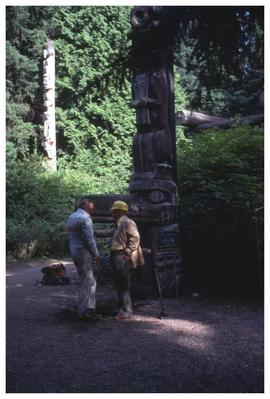
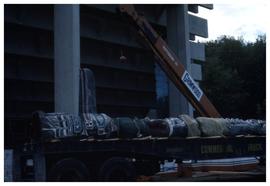
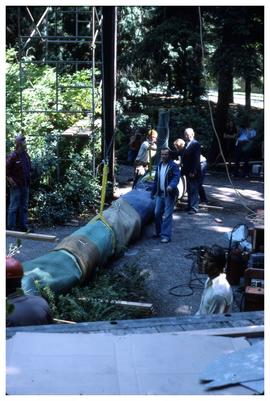
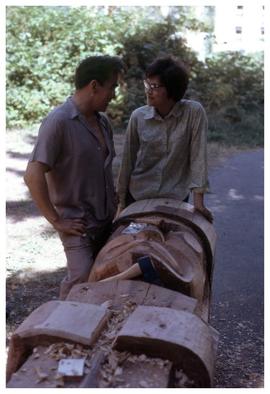
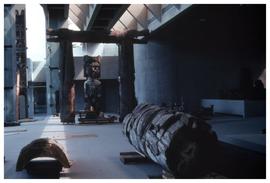
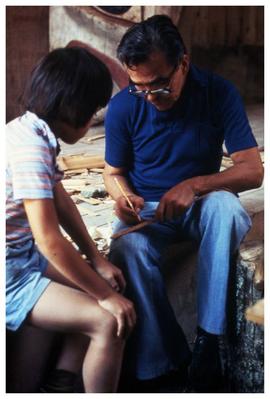
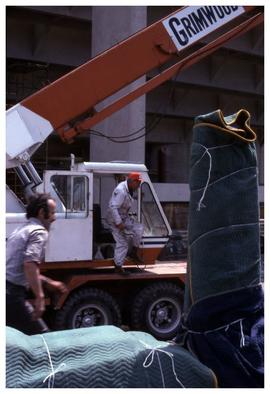
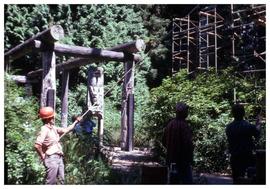
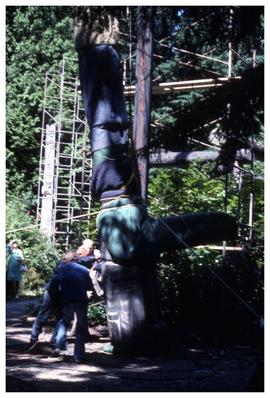
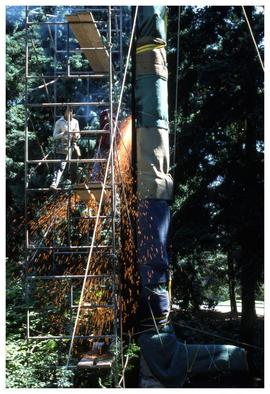
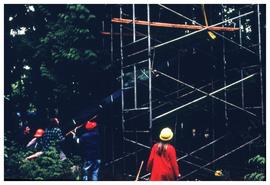
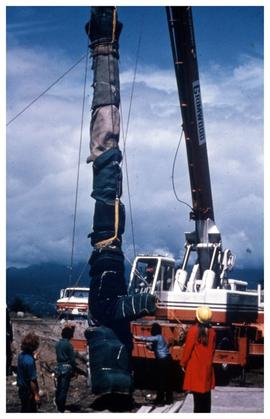
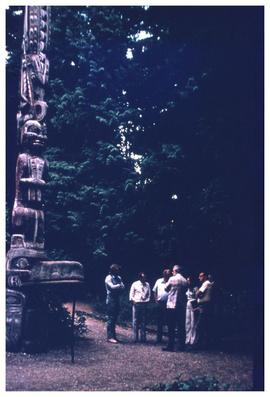
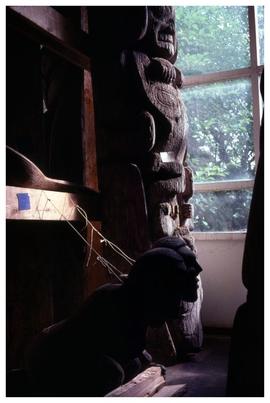
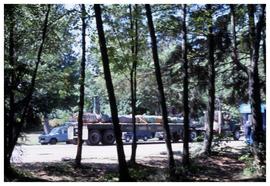
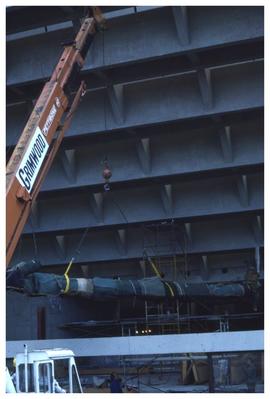
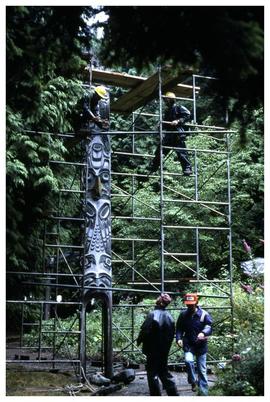
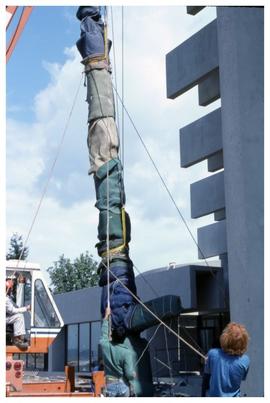
File consists of images of totem poles being moved to the new museum building and grounds. Many of these were moved from Totem Park on UBC's campus.
Aantekeningen
Materiële staat
Directe bron van verwerving
Ordening
Taal van het materiaal
Schrift van het materiaal
Plaats van originelen
Box 2.12