Gitxsan

Elements area

Taxonomy

Code

Scope note(s)

    Source note(s)

      Display note(s)

        Hierarchical terms

        Equivalent terms

        Gitxsan

        • UF Gitskan

        • UF Gitksan

        Associated terms

        Gitxsan

          54 Archival description results for Gitxsan

          54 results directly related Exclude narrower terms
          25-04-08 · File · 1969-1972
          Part of Anthony Carter fonds

          File consists of images of the Skeena River valley area in British Columbia, near Hazelton. Subjects include people, totem poles, scenery, and the the villages of Gitsegukla and Kitwancool.

          Anthony Carter
          Barrie Reynolds
          29-2-30 · File · 1970
          Part of Wilson Duff fonds

          This file contains a letter and attached report written by Wilson Duff at the request of Barrie Reynolds, chief ethnologist at the National Museum of Man [Canadian Museum of History]. The contents relate to the valuation of a collection of Northwest Coast cultural belongings and other items that a Mr. Birmingham intended to sell to the museum. Duff provides an overarching analysis of the collection and comments on the discrepancies between (1) museum valuation and its emphasis on ethnological information, and (2) an art market in which investors view objects and belongings based on aesthetic qualities and their potential as investment pieces.

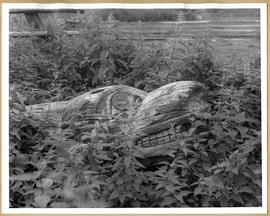
          Broken totem pole
          94-a034823 · Item · 1948
          Part of Stanley E. Read fonds

          Image depicts a part of a fallen totem pole, surrounded by foliage. The animal may be a wolf; it depicts teeth in an open mouth.

          Bruce Rigsby
          29-2-31 · File · 1965-1970
          Part of Wilson Duff fonds

          This file contains correspondences from Bruce Rigsby to Wilson Duff. Rigsby summarises his meetings with a number of Gitxsan, Nisga'a, and Tsimshian individuals, including the recording of information about houses of specific kinship lineages (or clans) and other oral histories. Rigsby also includes a proposed orthography for Nisga'a and Gitxsan, a copy of his article "A note on Gitksan speech-play", and a copy of a conference paper "An early nineteenth century prophet among the Gitksan". Records in this file refer to the Nisga'a people as Nass.

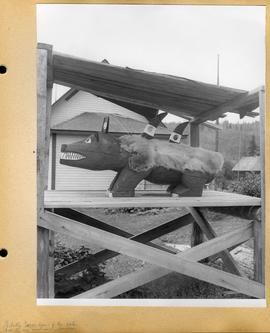
          94-a034843 · Item · 1948
          Part of Stanley E. Read fonds

          Image depicts a carving of a creature that resembles a bear--with fins. The carving sits on a wooden structure, possibly a carver's bench. Several buildings can be seen behind the carving platform.

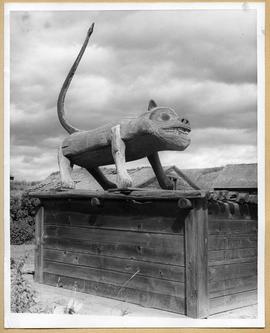
          Carving of Hawaao
          94-a034849 · Item · 1948
          Part of Stanley E. Read fonds

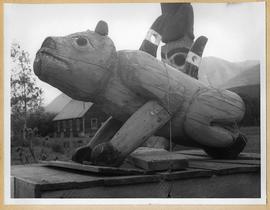
          Image depicts a carving of an animal that resembles a mountain lion. This carving is a part of the Poles of Arhteeh in Kitwanga.

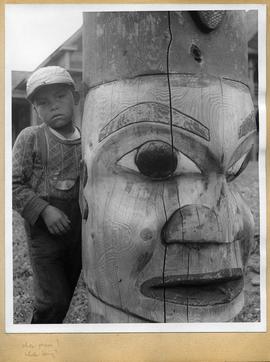
          Child and totem pole
          94-a034827 · Item · 1948
          Part of Stanley E. Read fonds

          Image depicts a child leaning against the base of a totem pole. The pole shows a human figure in profile. See also item a034828 for another view of this pole.

          According to George Read, Stanley Read's son, the pole in the image is the Half Way Out pole of Delgamuukw's house; the boy is Harry Brown, whose Gitxsan name is Xsuwii 'Guus.

          94-a034828 · Item · 1948
          Part of Stanley E. Read fonds

          Image depicts a child leaning against the base of a totem pole. The pole shows a human figure with an open mouth. See also item a034827 for another view of this pole.

          According to George Read, Stanley Read's son, the pole in the image is the Half Way Out pole of Delgamuukw's house; the boy is Harry Brown, whose Gitxsan name is Xsuwii 'Guus.

          Dan Savard
          29-2-34 · File · 1975
          Part of Wilson Duff fonds

          This file contains a correspondence between Dan Savard with the Ethnology Division of the BC Provincial Museum [Royal BC Museum] and Wilson Duff. It concerns a request to Duff about the dates when images of several objects were taken. It also includes a request for bibliographic information about photographer J.B. (Jack) Scott. The images include Haida bentwood boxes and D-adzes tools from Skidegate and Gitxsan totem poles (erroneously labelled as Tsimshian) from a location near Hazelton.

          25-04-08-a038470 · Item · August 1970
          Part of Anthony Carter fonds

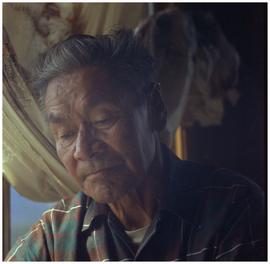
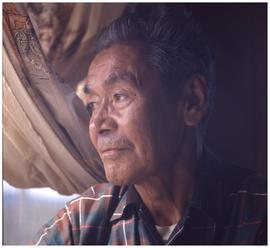
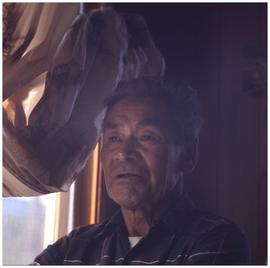
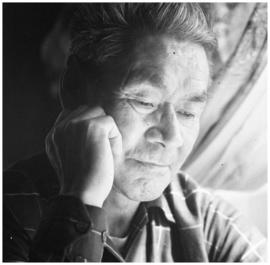
          Portrait of David Gunanoot, Chief of Gitxen. A similar portrait of him is printed on page 107 of Carter's book Abundant Rivers.

          Anthony Carter
          25-04-08-a038482 · Item · August 1970
          Part of Anthony Carter fonds

          Portrait of David Gunanoot, Chief of Gitxen. A similar portrait of him is printed on page 107 of Carter's book Abundant Rivers.

          Anthony Carter
          25-04-08-a038483 · Item · August 1970
          Part of Anthony Carter fonds

          Portrait of David Gunanoot, Chief of Gitxen. A similar portrait of him is printed on page 107 of Carter's book Abundant Rivers.

          Anthony Carter
          David Gunanoot, Haselton, BC
          25-04-08-a038488 · Item · [1972?]
          Part of Anthony Carter fonds

          Portrait of David Gunanoot, Chief of Gitxen. A similar portrait of him is printed on page 107 of Carter's book Abundant Rivers.

          Anthony Carter
          Fallen totem pole
          94-a034834 · Item · 1948
          Part of Stanley E. Read fonds

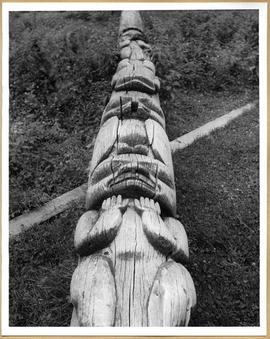
          Image depicts a totem pole lying on the ground. Figures are difficult to identify, but the most prominent one is probably human. Read`s diary indicates that this photo was probably taken at either the Kitwanga or Kispiox village site in Gitxsan territory of the Skeena Valley..

          George MacDonald
          29-2-25 · File · 1971
          Part of Wilson Duff fonds

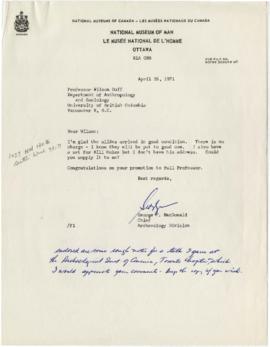
          This file contains correspondences between Wilson Duff and George F. MacDonald, chief of the Archaeology Division of the National Museum of Man. MacDonald shares the text of a talk he gave on art and architecture based on archaeological excavations of Haida and Tsimshian villages. The text details MacDonald's ethnohistorical interpretations of social, spiritual, and economic structures. In providing comments and critiques to the text provided by MacDonald, Duff also describes social practices among Gitxsan and Tsimshian communities as a point of comparison.

          Gitanyow
          1-4-E-2-2 · File · [ca. 2005]
          Part of William McLennan (MOA Curator) fonds

          File consists of photographic prints depicting Gitanyow cultural objects from other institutions. Many of the prints are annotated with handwritten, stamped, or typed information about the contents of the images or their original repositories. The contents of this file were used to create object labels for MOA Object ID A50019 in MOA's Great Hall.

          Gitxsan
          3-3-04 · Series · 1975, 1977-1982, 1987, 2002
          Part of Vickie Jensen and Jay Powell fonds

          Series documents Jensen and Powell’s work with and visits to the Gitxsan speaking villages in North Western British Columbia. Jensen and Powell worked with the Gitxsan to produce language and culture material.

          Jensen’s first visit to Gitxsan territory was in 1975, before they began to work with the communities. Jensen was asked to accompany Dr. Marjorie Halpen of the Museum of Anthropology, Amelia Sussman Schultz (a former student of anthropologist Franz Boas) and UBC grad student Carol Sheehan McLaren to Prince Rupert and various Gitxsan villages. The impetus for the journey was that Schultz was interested in recovering her old dissertation notes that she left with William Beynon, a hereditary Tsimshian chief who served as ethnographer, translator, and linguistic consultant to anthropologists including Boas. Although she had never completed her dissertation, in her retirement she regretted leaving the information. During this trip Jensen photographed the Gitxsan villages through which they travelled, making special note of the burial houses and totems she encountered.

          Two years later the Gitxsan band approached Jensen and Powell to create language and culture materials. Powell secured the funding through the BC Ministry of Education and the federal government.

          Powell and Jensen lived and worked with the Gitxsan in the summers from 1977 to 1981. The first three years were spent focussing on what they have termed the Eastern dialect. In this period they lived and worked in Kispiox, staying in a teacherage the first year (a small apartment built for housing teachers), and moving in the second year to the back room of the house of one of their linguistic informants, Clara Harris. The third year they again lived with Clara Harris until halfway through the summer when they decided to expand the project to include the Western dialect: at this time they moved to Kitwancool (now known as Gitanyow) where they again lived in a teacherage. The final two summers they returned to Kispiox to live with Clara Harris.

          Powell worked with a number of linguistic informants, including Clara Harris, Edith Gawa, and Mary Johnson for the Eastern dialect, and Solomon Marsden, with the help of Ivan Good, Maggie Good, Cindy Morgan, Edith and Abel Campbell, David Milton, Olive Mulwain, Fred Johnson and Jeffrey Morgan for the Western. The materials produced throughout the Gitxsan project are divided into Eastern and Western Gitxsan. The books produced for the Eastern dialect were called Gitxsan for Kids. The books for the Western dialect were called Learning Gitxsan. In addition to the educational material, other resources were developed including illustrated alphabet sheets, the Northwest Coast Word List (which was intended as the basis for a full dictionary, a goal that did not transpire), and the Gitxsan Teacher’s Manual.

          As was the case with all the communities they lived in, Powell and Jensen found that work and recreation in small Indigenous communities blended together, and many of the activities they took part in were incorporated into the language materials produced. Jensen photographed the cultural activities they attended, and they made audio and photographic records of Elders reminiscing about what they referred to as the “old ways.” Both Jensen and Powell were adopted into Gitxsan tribes during their time living in the region: Jensen to the Firweed Clan, and Powell to the Lax Gibuu, or Wolf Clan, both of Kispiox. This series comprises all the records created during their stays in Gitxsan villages.

          The series consists of nine sub-series:
          A. Field notes and correspondence
          B. Research
          C. Published educational materials
          D. Unpublished manuscripts
          E. Tsimshian-Gitxsan materials
          F. Eastern and Western Gitxsan recordings
          G. Eastern Gitxsan photographs
          H. Western Gitxsan photographs
          I. Doreen Jensen
          J. Gitxsan artist photographs

          Gitxsan
          1-4-C-9 (64.4-5) · File · [199-?]
          Part of William McLennan (MOA Curator) fonds

          File contains historical photographs of Gitxsan villages, with a specific focus on totem poles and various buildings in the villages. There are also some images of the Gitxsan people in regalia. The textual records contain information to some of the photographs, listing the photograph's title and the museum and/or archive it originated from.

          94-a034848 · Item · 1948
          Part of Stanley E. Read fonds

          Image depicts a close up of a carving of a creature that resembles a grizzly bear with fins on its back. This carving is similar to the one depicted in item a034843.

          25-04-08-a038399 · Item · November 1969
          Part of Anthony Carter fonds

          Image of a totem pole in Gitsegukla owned by Gary Hill Sr. of the house of Wiiseks/Wiigyet. The pole was cut down and as of March 2019 there are plans to make another one.

          Additional images of this pole are printed on page 122 of Carter's book Abundant Rivers.

          Anthony Carter