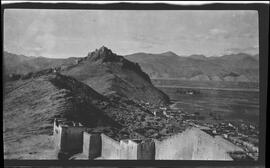
Item is a negative showing a bird's eye view of the village of Gyantse. There are mountains in the background.
Elements area
Taxonomy
Code
Scope note(s)
Source note(s)
Display note(s)
Equivalent terms
Tibet
UF Tibet
UF Tibet
Item is a negative showing a bird's eye view of the village of Gyantse. There are mountains in the background.
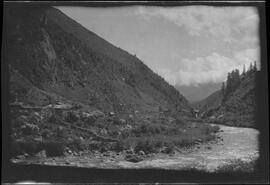
Item is a negative of the mountainous Chumbi Valley. There is a river in the forefront of the image.
The fonds consists primarily of material accumulated and/or created by Lt. Col. Parker during the period of his military duties in Tibet and time spent there after his release from the military (1921-1924). This material includes textual records such as correspondence relating to military matters with Sir Charles Bell, and those written to, and received from, Tibetan officers and the 13th Dalai Lama. A few letters written in Tibetan have been recently translated into English and are included in the fonds. Other textual materials includes handwritten speech and other notes, published documents such as an Almanac (written in Tibetan), newspaper clippings, and miscellaneous items such as philatelic materials and handwritten children's rhymes and songs.
The fonds also contains a collection of black and white photographs and negatives, the majority of which were images taken by Lt. Col. Parker, while others, predate Parker’s time in Tibet. The photographs are housed in two albums (Photograph Collections A and B), and show Tibet primarily in the 1920s. The images depict military and domestic scenes in Tibet including photographs of individuals from all social strata, as well as local architecture and landscapes. Some of the places (e.g., monasteries) no longer exist. The albums also contain more recent colour prints of the many Tibetan objects acquired by the Parkers (and now housed in the Ethnology Collection at the Museum of Anthropology). Some duplicates occur within and between albums. The negatives correspond to prints in one album (Photograph Collection A). Only a small number of negatives have not been printed.
The fonds is arranged in the following 3 series:
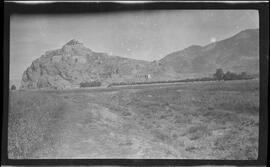
Item is a negative showing a small village in the distance. There are also mountains in the background.
Item is a negative showing several buildings in the village of Gyantse.
Item is a negative showing a head on look of the small village of Gyantse. There is a road in the forefront of the image where three 90th Punjabi soldiers walk ahead of a Tibetan solider on the right bank of the road. There are mountains in the background.
Item is a negative showing Gyantse village. Gyanste Jong can be seen in the background. There are mountains in the distance.
Item is a negative showing several buildings in the village of Gyantse.
Item is a negative showing Gyantse village. There are mountains in the distance.
Item is a negative showing Gyanste Jong located at the top of a spur from a distance.
Item is a negative showing Gyanste Jong from a distance. Gyantse is also visible at the bottom lefthand side of the image.
Item is a negative showing Gyanste Jong from a distance.
Item is a negative showing Gyanste Jong located at the top of a spur from a distance. There are several buildings at the bottom of the spur.
Item is a negative showing Gyanste Jong located at the top of a spur from a distance.
Item is a negative showing a Gyantse Fort, located on the top of a rocky spur. There are smaller buildings at the bottom of the spur.
Item is a negative showing a close up of a busy marketplace in Gyantse.
Item is a negative showing a busy marketplace in Gyantse. There are mountains in the background.
Item is a negative showing Gyantse village from above. The town's monastery is visible in the centre of the image.
The Palcho or Pelkor Chode Monastery, Gyantse.
The monastery’s main temple was built between 1418 and 1428 and its Kumbum stupa was completed in 1437, by ruler Rabten Kunzang Phak. Kumbum refers to “a hundred thousand images,” representing the number of deities depicted inside. Tsang Province in Gyantse is home to three renowned Kumbum stupas: Gyantse Kumbum—the largest—Jonang Kumbum, and Chung Riwoche Kumbum, all in proximity to the town of Shigatse.