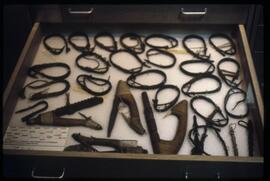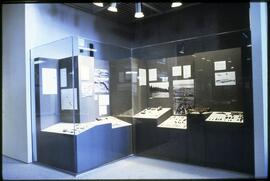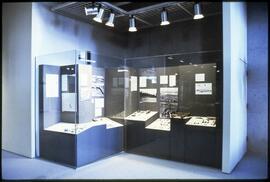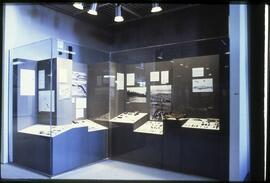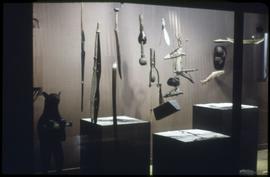
A bear figure, fish hooks, and other items on display in Montréal for the Museum of Anthropology's Northwest Coast exhibit for "Man and His World".
Fishing & hunting gear
21 Archival description results for Fishing & hunting gear
Image of a Nuu-chah-nulth harpoon head
File contains correspondence and art packages. The two art packages consists of Northwest Coast Art and The Whale House of the Chilkat. These packages contain historic photographs with full explanations, as well as high lighting the design elements. They were published by the Alaska State Museum.
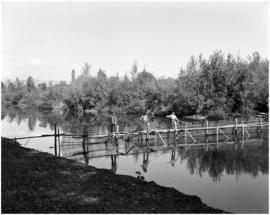
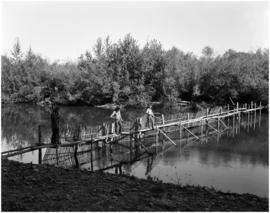
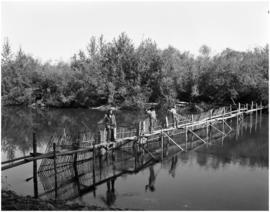
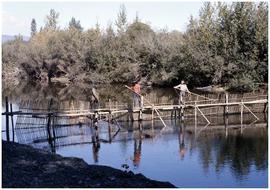
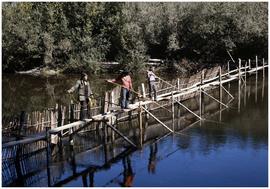
Image of three individuals standing on the platform of a fishing weir on the Cowichan River, holding spears. A similar image is printed on page 15 of Carter's book "From History's Locker," with the caption: "Salmon weir on the Cowichan river, the native people continue a very ancient form of spear fishing for migrating salmon. The weir is not a trap but merely a means to slow the fish on the way up the river."
Anthony Cartermage of three individuals standing on the platform of a fishing weir on the Cowichan River, holding spears. A similar image is printed on page 15 of Carter's book "From History's Locker," with the caption: "Salmon weir on the Cowichan river, the native people continue a very ancient form of spear fishing for migrating salmon. The weir is not a trap but merely a means to slow the fish on the way up the river."
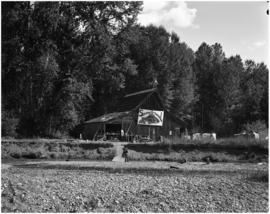
Anthony CarterImage of a wooden building with a sign hanging from the front of it that says "Salmon for Survival." The building appears to be a place where salmon is processed, dried, and/or sold. It is located next to a creek or low lying river.
Anthony Cartermage of three individuals standing on the platform of a fishing weir on the Cowichan River, holding spears. A similar image is printed on page 15 of Carter's book "From History's Locker," with the caption: "Salmon weir on the Cowichan river, the native people continue a very ancient form of spear fishing for migrating salmon. The weir is not a trap but merely a means to slow the fish on the way up the river."
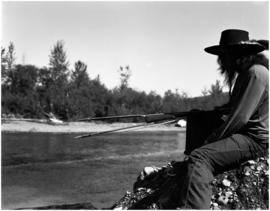
Anthony CarterImage of a man seated on the side of the Cowichan River (Vancouver Island) holding a fishing spear.
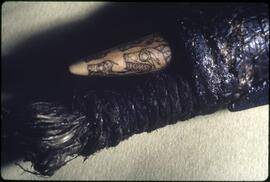
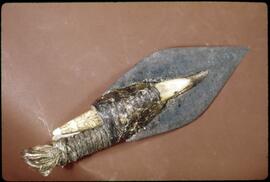
Anthony CarterDetail of a decorated barb from a harpoon head.
Fish hooks in a display in drawer in visible storage at the Museum of Anthropology.
This file contains images of Coast Salish and Kwakwaka'wakw artifacts. Many of the photos are official photographs taken by various museums in Canada and the United States, but others are historical photos. These artifacts include masks, rattles, carvings, fishing equipment and fish processing, canoes, and North Coast architecture, such as long houses and house posts.
Item of North Pacific Coast Indigenous peoples on display in the Museum of Anthropology. Most items appear to be related to fishing.
The file contains images of Northwest Coast artifacts located in unidentified First Nation villages, and in various museums in North America. The artifacts include masks, paddles, carvings, rattles, fishing equipment, and household items such as bowls and spoons. The majority of images from various museums include information about the artifact such as what it is, the museum it's housed in, and the artifact's catalogue number.
Subseries consists of material produced by museum staff, among them Wilson Duff, Harry and Audrey Hawthorn, Marjorie Halpin, and Gloria Cranmer Webster. There is extensive material on Audrey Hawthorn’s Art of the Kwakiutl Indians. Included in this subseries are ca. 2000 photographs which were collected for possible use in this book. Photographs are numbered A38-A17206 with many numbers missing throughout. The majority of photographs are of wooden masks, but they are also of bowls, bentwood boxes, paddles, rattles, totem poles, talking sticks, headdresses and frontlets, wooden figures and miniatures, whistles, spoons, silver bracelets, argillite carvings, button blankets, chilkat blankets, cedar head and neck rings, woodworking tools, stone tools, and fish hooks. Other record forms included in this subseries include correspondence, notes and published materials.
Display for the Museum of Anthropology. Uncertain relation to exhibits. Possibly for an Oceania exhibit that may have been in place in 1969. Shows a variety of fishing implements including hooks, lures, nets, and harpoons.
Display for the Museum of Anthropology. Possibly for an Oceania exhibit that may have been in place in 1969. Shows adzes fishing tools, jewelry, a map of the Kula trade ring, and other items.