Gitanyow

Elements area

Taxonomy

Code

Scope note(s)

    Source note(s)

      Display note(s)

        Hierarchical terms

        Gitanyow

        Gitanyow

          Equivalent terms

          Gitanyow

          • UF Kitwancool

          Associated terms

          Gitanyow

            9 Archival description results for Gitanyow

            9 results directly related Exclude narrower terms
            25-04-08 · File · 1969-1972
            Part of Anthony Carter fonds

            File consists of images of the Skeena River valley area in British Columbia, near Hazelton. Subjects include people, totem poles, scenery, and the the villages of Gitsegukla and Kitwancool.

            Anthony Carter
            Bear pole, Kitwancool
            25-04-08-a038446 · Item · [197-?]
            Part of Anthony Carter fonds

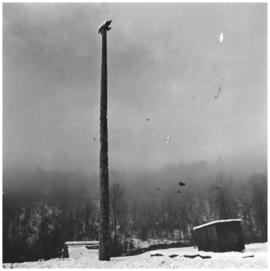
            Image of a bear pole in Kitwancool, BC. This pole is pictured on page 119 of Carter's book Abundant Rivers.

            Anthony Carter
            Charles E. Borden fonds
            140 · Fonds · ca. 1954

            The fonds consists of a file titled Tsimshian Totem Poles and contains 38 black and white photographs of Kitwancool totem poles.

            Charles E. Borden
            Gitanyow
            1-4-E-2-2 · File · [ca. 2005]
            Part of William McLennan (MOA Curator) fonds

            File consists of photographic prints depicting Gitanyow cultural objects from other institutions. Many of the prints are annotated with handwritten, stamped, or typed information about the contents of the images or their original repositories. The contents of this file were used to create object labels for MOA Object ID A50019 in MOA's Great Hall.

            Gitxsan
            1-4-C-9 (64.4-5) · File · [199-?]
            Part of William McLennan (MOA Curator) fonds

            File contains historical photographs of Gitxsan villages, with a specific focus on totem poles and various buildings in the villages. There are also some images of the Gitxsan people in regalia. The textual records contain information to some of the photographs, listing the photograph's title and the museum and/or archive it originated from.

            144-1-6 · File · 1969-1973
            Part of Minn Sjolseth fonds

            File consists of slides depicting totems and views labeled as in Kispiox, Kitwancool, Ketchikan, Haida, Kitseguckla, Skedans, and Kingcome. File also consists of slides documenting two of Minn Sjolseth's paintings entitled "En av de Siste" (sp?) and "Peace."

            51-01-28-a039409 · Item · 1955 or 1956
            Part of Harry B. Hawthorn fonds

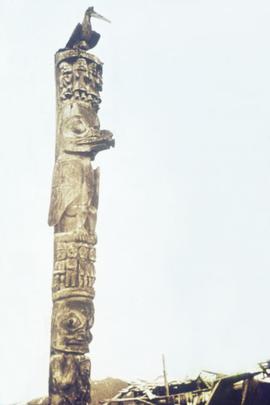
            Totem pole in Kitwancool / Gitanyow outside the house of Wii Xá, a chief of the Lax Gibuu clan of the Gitanyow. Features a carved bird on top, two other larger figures below, and two rows with bands of much smaller carved figures. Known as the pole of Skim-sim and Will-a-daugh. Pole is now at MOA - object ID: A50019.

            Totem pole at Kitwancool
            132-1-C-E-a042793 · Item · [19--?]
            Part of MOA General Media collection

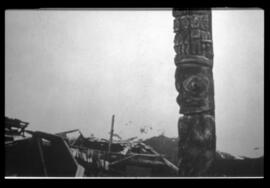
            Totem pole standing in situ at Kitwancool. It was later removed and taken to the University of British Columbia. It currently stands in the Great Hall at the Museum of Anthropology.

            3 · Fonds · 1969 - 2021

            Fonds consists of records relating to the numerous culture and language projects that Powell and Jensen worked on since 1976. The communities with which they worked include:
            • The Quileute of La Push
            • The Kwakwaka’wakw of Alert Bay
            • The Gitxsan of Kispiox, Gitanyow, and surrounding villages
            • The Nuu-chah-nulth of Vancouver Island
            • The Musqueam of Vancouver
            • The Seton Lake St'at'imc (Lillooet) of Shalalth
            • The Shuswap of Alkali Lake, Soda Creek, Dog Creek, Canim Lake, and Sugar Cane
            • The Haisla of Kitamaat
            • The Nisga’a of Gingolx (Kincolith) and New Aiyansh

            Most of the projects had an end goal to produce a book, language education materials, or teacher training materials. Often the education materials incorporated cultural lessons throughout. The records created in the production of the books are varied and reflect the intrinsic connection between language, culture, and daily activities in the communities. Powell and Jensen were co-editors for nearly all of the language books and materials produced. Although some of the projects reflected in the records were done primarily by Powell or primarily by Jensen, the vast majority of the work involves collaboration between the two in some aspect. As Jensen and Powell immersed themselves in the communities they worked for, often their personal photographs and records are interspersed with those relating to their work. This community involvement enhanced their relationships with the people with whom they were working and allowed them to experience and participate in cultural activities as part of those communities. This close relationship is reflected in and is integral to their work. Jensen and Powell have two sons: Nels, born in 1978, and Luke, born in 1981. Their sons travelled with them to the communities in which they worked and lived, and on their work trips and sabbaticals. Nels and Luke are also present in many of the photographic records.

            The records contain a mixture of research, field notes, administrative records, and publications at various stages, in addition to audio and visual records. Field notes, for the most part handwritten, and archival research into language and culture groups was undertaken by Powell, whilst the majority of the photography, found in a variety of formats, was done by Jensen. Manuscripts and final publications were a combined effort and are included at various stages. Administrative records, including grant proposals, are found throughout.

            Fonds consists of 13 series of records. Series are arranged according to community and/or project.

            Vickie Jensen and Jay Powell