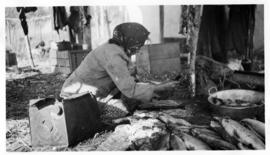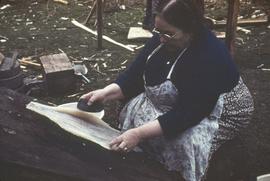
Abaya Martin slicing fish to be sun-dried.
Elements area
Taxonomy
Code
Scope note(s)
Source note(s)
Display note(s)
Hierarchical terms
Fish processing
NT Canneries
NT Canneries
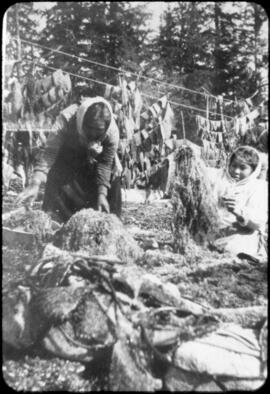
Abaya Martin slicing fish to be sun-dried.
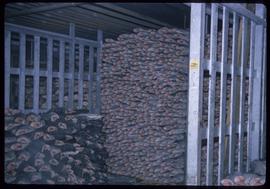
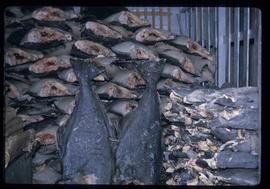
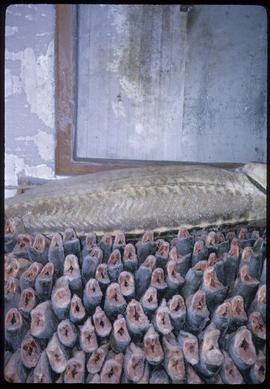
Photograph of a pile of partially processed salmon in a cannery.
Photograph of piles of partially processed salmon in a cannery.
Photograph of a pile of partially processed salmon in a cannery.
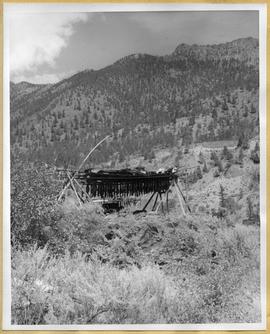
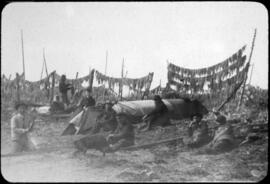
Image depicts a rack set up in a clearing where fish appear to be drying. The area around the rack is scrub land and mountains can be seen in the distance.
Image of fish and what appears to be seaweed drying. The slide label appears to describe the people as Athabascan but this is uncertain. This image may be from a book by Marius Barbeau or Edward Linnaeus Keithahn.
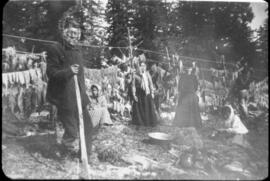
Image of fish being hubg to dry, according to caption on slide. The origins of this photograph are uncertain.
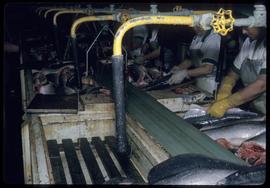
Photograph of a fish processing line, likely in a canning factory.
Image of a eulachon fishery in Fishery Bay, seen from the Nass RIver. The fishery is along the shore, with mountains in the background.
Images of net fishing in the Fraser River Canyon with traditional Indigenous fish processing techniques.
This file contains images of Coast Salish and Kwakwaka'wakw artifacts. Many of the photos are official photographs taken by various museums in Canada and the United States, but others are historical photos. These artifacts include masks, rattles, carvings, fishing equipment and fish processing, canoes, and North Coast architecture, such as long houses and house posts.
File mainly contains historical images of the Heiltsuk, Nuxalk, and Wuikinuxv First Nations. These images depict village life, architecture and house posts, and regalia. The file contains images of a group of Nuxalk who traveled to Berlin to perform there. Images that are not historical depict a ceremony happening in the Great Hall at UBC MOA, unidentified artists working on a set of drawings, and what appears to be the Acwsalcta High School in Bella Coola. Non textual records include photocopies of photographs, and photocopies of museum catalogue cards.
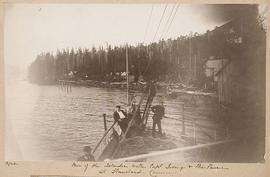
Item is an image of ship's bow with three people posing and a aoastal village in the background. According to annotations, the ship is the Islander and the background is Standard Cannery.
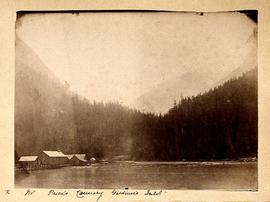
Item is an image of five buildings by a coast. According to annotations, photographs was taken in Gardiner's Inlet and buildings are of Mr. Price's Cannery.
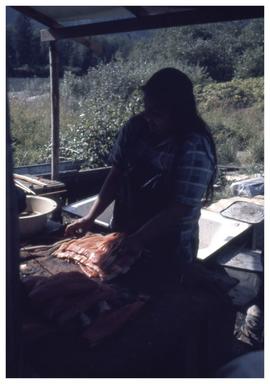
Item is an image showing a woman preparing fish.
C. MacKayImage of Kingcome Inlet resident Mrs. Sam Weber preparing salmon for the smokehouse. A similar image is printed on page 45 of Carter's book From History's Locker.
Anthony CarterFile contains a combination of historical photographs depicting village life of the Coast Salish people, and modern day photographs of Salish artifacts housed in various museums around the world. The historical photographs contain images of Coast Salish peoples, totem poles, house posts, canoes, and petroglyphs. The modern day photographs contain images of Coast Salish artifacts such as blankets, spindle whorls, masks, carvings, house posts and totem poles, and household items such as combs and bowls. The textual records contained in this file are photocopies of images of Coast Salish artifacts housed in various museums around the world.
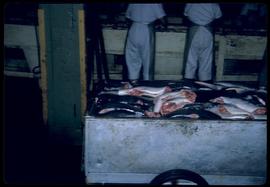
Photograph of a fish processing line, likely in a canning factory. This image shows a cart full of partially processed salmon, with two worked in the background.
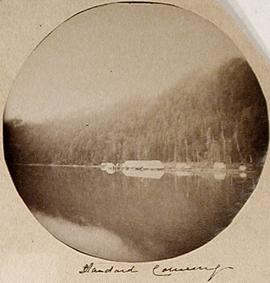
Item is an image of several buildings by a coast. According to annotations, buildings are the Standard Cannery.