Item is a photograph showing a landscape with a river in the foreground and mountains in the background. A single house is in the centre. According to the Oxford English Dictionary, a <i>dak</i> is referred to as being "a post system by means of transport relays of horses stationed at intervals along a route or network, carrying mail and passengers". A dak bungalow refers to a lodging house, typically one story with a large verandah, along a dak route.
Houses
68 descrição arquivística resultados para Houses
Item is a negative showing a two women, Vera Kamchi and Minnie Parker, standing in front of a tall wooden fence. The fence is in front of a large house with snow on the roof. There is a mountain covered in snow in the background.
Item is a negative of a one story building covered in snow. There is a mountain with trees in the background.
Item is a photograph of a garden with a house-like structures in the background.
File contains copies of images held at the Royal British Columbia Museum Archives and a pdf document titled "The Role of the Royal Canadian Mounted Police During the Indian Residential School System" produced by the RCMP.
This file contains images of Coast Salish and Kwakwaka'wakw artifacts. Many of the photos are official photographs taken by various museums in Canada and the United States, but others are historical photos. These artifacts include masks, rattles, carvings, fishing equipment and fish processing, canoes, and North Coast architecture, such as long houses and house posts.
The majority of this file contains historical images of the Tlingit and Tahltan First Nations and their respective villages. The other images are of Tlingit or Tahltan artifacts housed in various museums in Canada and the United States. The historic images are of Tlingit or Tahltan villages which include images of Northwest Coast architecture, houses posts and totem poles, canoes, and other household items such as bowls, weavings, and bentwood boxes. There are also some images of the Tlingit people in regalia. The textual records contained in this file is a paper titled "The History of the Babine Carriers," written by Wilfred Adam for the class Education 479, Cross Cultural Education.
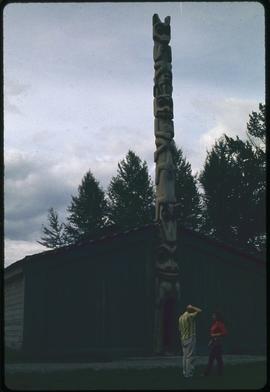
File contains images of various First Nations Cultural groups from the Pacific Northwest. The images include negatives and slides of Northwest Coast villages, totem poles, longhouses, and First Nations peoples dressed in regalia.
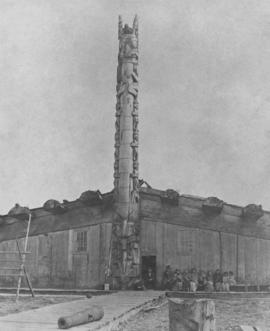
Image depicts exterior view of Chief Wiah's Monster House and frontal house post in Masset, Haida Gwaii, B. C. In front of the house are ten seated figures. Image appears to be reproduction of a039353.
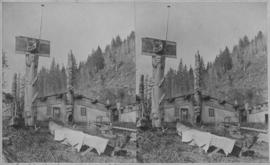
Image depicts exterior view of the Mountain House, frontal pole, house post, and mortuary pole located on Moresby Island in Haida Gwaii, B. C. In the foreground is a canoe. Printed around the border of the image is the photographer information "PHOTOGRAPHED BY R. MAYNARD, VICTORIA, . . . B. C." Handwritten inscription on the border reads "Gold Harbour Q. Ch. Is.". Printed on the verso is the photographer information with the inscription "R. Maynard, Photographic Artist, AND DEALER IN ALL KINDS OF PHOTOGRAPHIC MATERIALS, COR. OF DOUGLAS AND JOHNSON STS., VICTORIA, B. C. -- Views of British Columbia and Vancouver Island for Sale." A handwritten inscription reads "Indian Village".
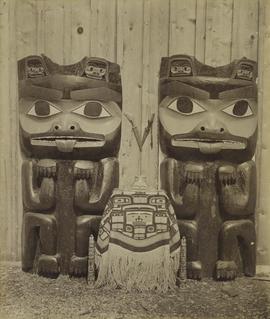
Image depicts interior posts of the Grizzly Bear House, Masset, B. C. (same as in a039354). The posts are displayed with a Chilkat blanket, painted hat, and two daggers that probably belonged to Xa’na. The Chilkat blanket is draped over a box that may be the coffin box of Xa’na. Printed below the image is "R. Maynard, Artist". Printed on the verso is the photographer information with the inscription "R. Maynard, Photographic Artist, AND DEALER IN ALL KINDS OF PHOTOGRAPHIC MATERIALS, COR. OF DOUGLAS AND JOHNSON STS., VICTORIA, B. C. -- Views of British Columbia and Vancouver Island for Sale." A handwritten inscription reads "Indian Totems."
Image depicts an exterior view of a church and mission house in Skidegate, Haida Gwaii, B. C.
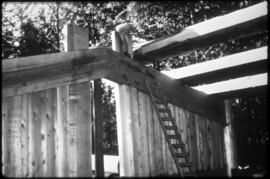
Photo of artists Doug Cranmer guiding a roof beam into place. This photograph was taken during the original construction of the Haida house in Totem Park.
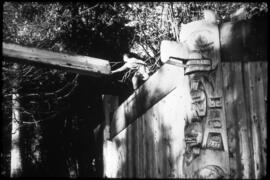
A man stands on a section of the Haida house roof, possibly securing a beam into place.
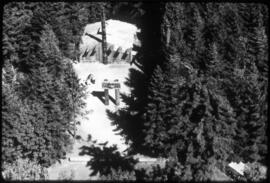
Aerial view of Haida House after construction and carvings were complete. The date of the annotation must be incorrect as the double mortuary pole and the house front totem pole were not completed until 1962.
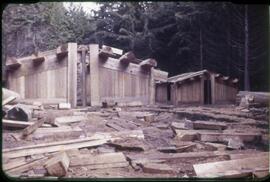
The Haida House and Mortuary House under construction in their original locations in Totem Park.
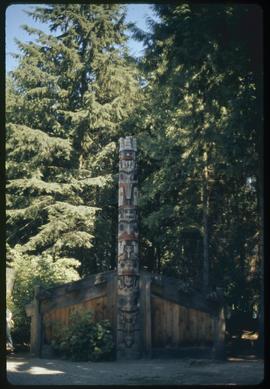
Mortuary House frontal pole by Bill Reid and Doug Cranmer (1960-61) moved from Totem Park to MOA in 1978.