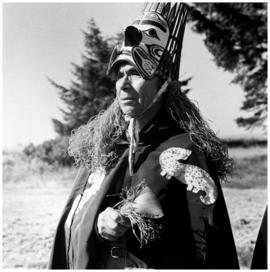
Johnny Williams returning headdress to Yuquot - Jimmie John
- 25-03-11-a038130
- Item
- [1972?]
Parte de Anthony Carter fonds
Image of an older man (possibly Mr. Wilson) wearing traditional robes and mask of the Nuu-chah-nulth
Sem título


13494 resultados com objetos digitais Mostrar resultados com objetos digitais
Johnny Williams returning headdress to Yuquot - Jimmie John
Parte de Anthony Carter fonds
Image of an older man (possibly Mr. Wilson) wearing traditional robes and mask of the Nuu-chah-nulth
Sem título
Miscellaneous Photographs and Prints
Parte de Anthony Carter fonds
File consists of miscellaneous photographs and printed materials, including personal photographs, prints from Carter's book, and magazines.
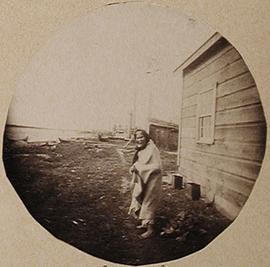
Parte de Robert Reford fonds
Item is an image of a woman by a building. There are some buildings, poles, and canoes in the background. According to annotations, photograph was taken in G?aw (also known as Old Massett) in the Haida Gwaii archipielago
[File removed - returned to cretaor's family]
Parte de Pam Brown fonds
From Bush Life to Urban Living: A Profile of Max Deranger.
Deaccessioned in June 20025
The Wilson Duff papers consist of textual records, photographs, negatives, slides, maps, audio recordings, compact disks and one video tape that relate to Duff's activities, correspondences, and publications as one of the foremost researchers in Northwest coast Indian history, culture and traditions. Also included in the fonds are records relating to Duff’s work as an Anthropology professor at the University of British Columbia, his advisory and curatorial consultancy work, committee membership and the exhibit Images: Stone: B.C.
Records in the Wilson Duff fonds have been organized into the following seventeen series:
Series 1: Wilson Duff’s student papers (1949-1950)
Series 2: Correspondence (195?-1975)
Series 3: Published and unpublished articles (195?-1972)
Series 4: Site visits (195-)
Series 5: Northwest Coast research (195?-197?)
Series 6: Teaching materials (1965-1976)
Series 7: Committee and consultancy records (1966-1976)
Series 8: Personal records (1965-1976)
Series 9: Photographic records (195?-1976)
Series 10: Maps (1955-1976)
Series 11: Images: Stone: B.C. (1975-1977)
Series 12: Research notes and materials (196?-1976)
Series 13: Tsimshian files (1915-1976, predominant 1957-1971)
Series 14: Recordings (1962-1976)
Series 15: Creative writing (195?  - 197?)
Series 16: Posthumous writings on Duff (197? – 199?)
Series 17: Ephemera (195? – 197?)
Sem título
Parte de Director's fonds
Parte de Director's fonds
The fonds consists of records created by Carol Mayer at the University of British Columbia as Curator of Collections and Curator of Ethnology and Ceramics at the Museum of Anthropology, as a Department of Anthropology & Sociology Instructor, as Curator of Africa/Pacific, and as Curatorial Department Head. Also included are records relating to her role within the MOA Exhibition Committee. The fonds also contains records related to her role as an instructor at the Emily Carr College of Art and Design. The records consist mainly of textual material with a small amount of graphic material and small artifacts. The records include correspondence, memoranda, incoming loan agreements, exhibit receipts, exhibit proposals and forms, policy drafts, news releases, pamphlets, minutes of committee meetings, budgets, agendas, schedules, exhibition lists, facility reports, display labels, CD’s, sketches, journals, transcribed interviews, research notes, negatives, slides and photographs.
The records are arranged into the following series:
Administrative files 1987-2014
Exhibition files 1977-2013
Student Project files 1994-2013
See attached pdf document for descriptions of these series with file lists.
Sem título
Includes 19 colour slides of totems and sites in Nootka Sound on the west coast of Vancouver Island.
Sem título
‘Ksan doors/Pole, Walter Harris
Parte de Marjorie Halpin (MOA Curator) fonds
Parte de Marjorie Halpin (MOA Curator) fonds
Parte de Marjorie Halpin (MOA Curator) fonds
Includes copy of pamphlet about the 'Ksan doors, and a copy of MOA News from May 1986.
Parte de Marjorie Halpin (MOA Curator) fonds
Sub-series consists of textual records including documentation on the meaning behind the carved Museum of Anthropology doors and the ‘Ksan artists who worked on the project.
Parte de Marjorie Halpin (MOA Curator) fonds
Incudes press release, correspondence about plaque text and story depicted on the doors (1975), and clippings.
Parte de Director's fonds
Request for financial contributions for museum ('Ksan) doors
Parte de Audrey Hawthorn (MOA Curator) fonds
Parte de Audrey Hawthorn (MOA Curator) fonds
Parte de Audrey Hawthorn (MOA Curator) fonds
The records in this fonds were created by Paul Hockings and his students regarding MOA's Cesnola Collection, Sid and Florence Leary Collection, and the Baron van Haersolte van den Doorn Collection. Hockings’ notes, drawings, and photos were made while working at MOA with Audrey Hawthorn on an exhibit on Bronze Age Style in the Eastern Mediterranean. Most material was created in the spring of 1958 with a view to producing a monograph on the Cesnola Collection, though this was never finished. Included is Hockings’ 1963 article “Ceramic Style in Prehistoric Cyprus” and three students’ papers.
The records contained in this fonds include handwritten notes, correspondence, photographic prints, articles, and unpublished student papers. The fonds is organised into five files according to form.
Sem título
Chinese Peasant Textiles Art: Kwantung and Szechuan Provinces
Parte de Elizabeth Johnson fonds
Subseries consists of records relating to the exhibit, “Chinese Peasant Textiles Art.” This exhibit was proposed by Elizabeth Johnson and carried out by students. Records include notes, excerpts from articles, visitor survey forms, handwritten notations, hand-drawn diagrams of display cases, proposals and budgets.
Sem título